
The Lean Shop Floor Yellow Belt Series are designed and developed in a very simple way so that the shop floor staff with little or no formal education can understand. When a staff member completes all the 8 modules he / she can be awarded a certificate.

There are 8 modules namely:
1. Apply Lean Practices
2. Apply 5S Pinnciples
3. Undertake Root Cause Analysis
4. Apply Cost Factors
5. Apply Quick Changeovers
6. Apply JIT Principles
7. Apply TPM Principles
8. Sustain Process Improvements
This module Apply JIT Principles covers the following topics:
What JIT is
Basic concepts of JIT
Support techniques
Process improvements
Standardization
Streamlined production
Uniform-leveled production
Support techniques of Just in Time manufacturing.
Principles and reasons for standardizing work.
*Total number of slides = 63
You can also buy all the 8 modules at a discounted price. Pl look for "Shop Floor Series – All in 1"
Got a question about the product? Email us at support@flevy.com or ask the author directly by using the "Ask the Author a Question" form. If you cannot view the preview above this document description, go here to view the large preview instead.
Executive Summary
This presentation, "Lean Shop Floor Series - Course 6: Apply Just in Time Concepts," provides a comprehensive overview of Just in Time (JIT) manufacturing principles. It equips participants with the knowledge to implement JIT techniques effectively, focusing on waste reduction, improved efficiency, and enhanced customer responsiveness. By the end of the course, attendees will understand how to streamline production processes, standardize operations, and foster a culture of continuous improvement.
Who This Is For and When to Use
• Operations managers seeking to enhance production efficiency
• Lean practitioners aiming to implement JIT methodologies
• Quality control teams focused on reducing defects and waste
• Production staff looking to improve workflow and responsiveness
Best-fit moments to use this deck:
• During training sessions for new employees on JIT principles
• As a refresher for teams involved in lean manufacturing initiatives
• In workshops aimed at process improvement and standardization
Learning Objectives
• Define Just in Time (JIT) and its significance in manufacturing
• Describe the basic concepts and key differences of JIT compared to traditional methods
• Identify support techniques that enhance JIT implementation
• Analyze process improvements that lead to streamlined production
• Establish the importance of standardization in operational processes
• Implement continuous improvement practices using the PDCA cycle
Table of Contents
• Introduction to Just in Time (page 2)
• Definition and Key Differences (page 4)
• How JIT Delivers Value (page 12)
• Production Leveling Concepts (page 18)
• Kanban and Its Applications (page 22)
• Support Techniques for JIT (page 30)
• Process Improvements and Layout (page 40)
• Work Standardization Principles (page 50)
• Continuous Improvement Framework (page 60)
Primary Topics Covered
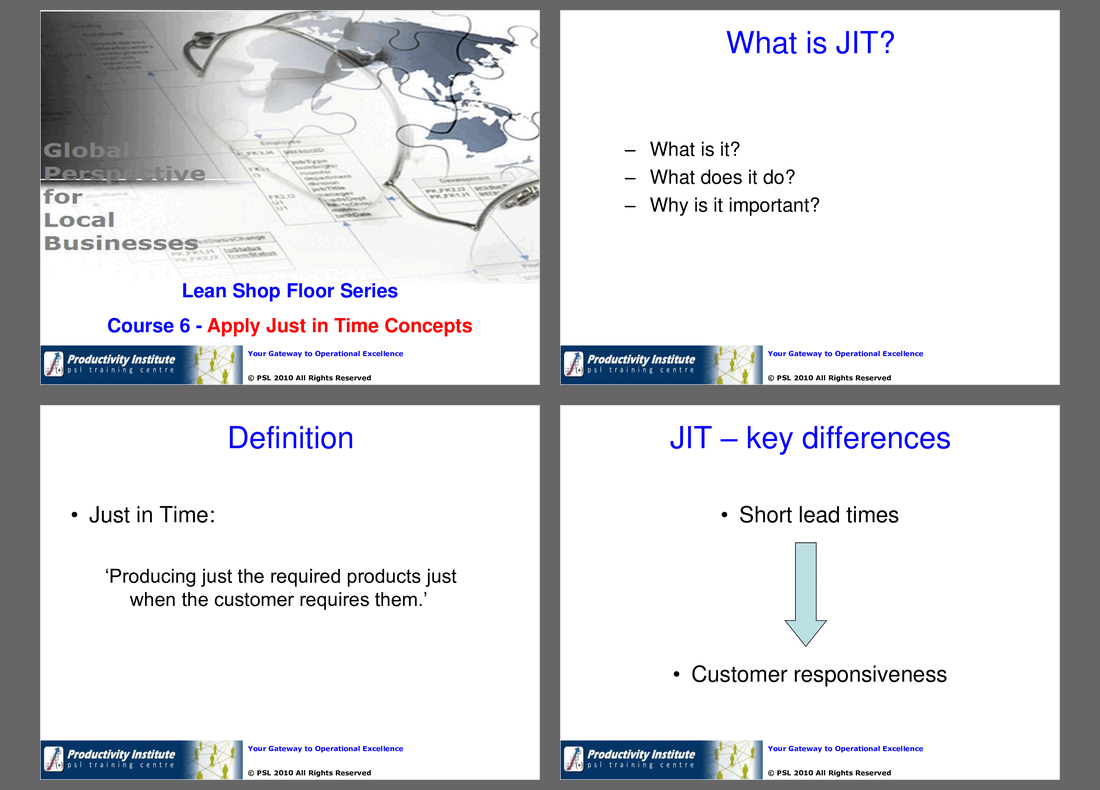
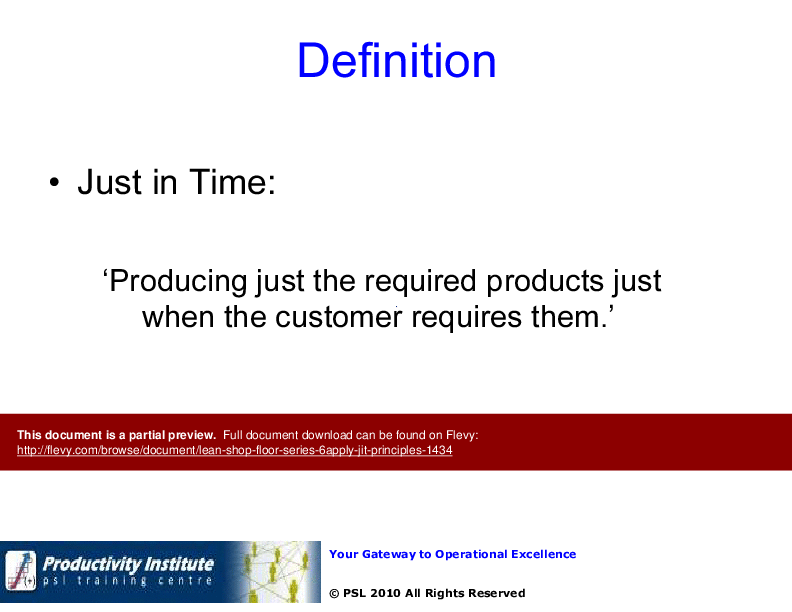
• Definition of JIT - JIT is defined as producing just the required products when the customer requires them, emphasizing efficiency and responsiveness.
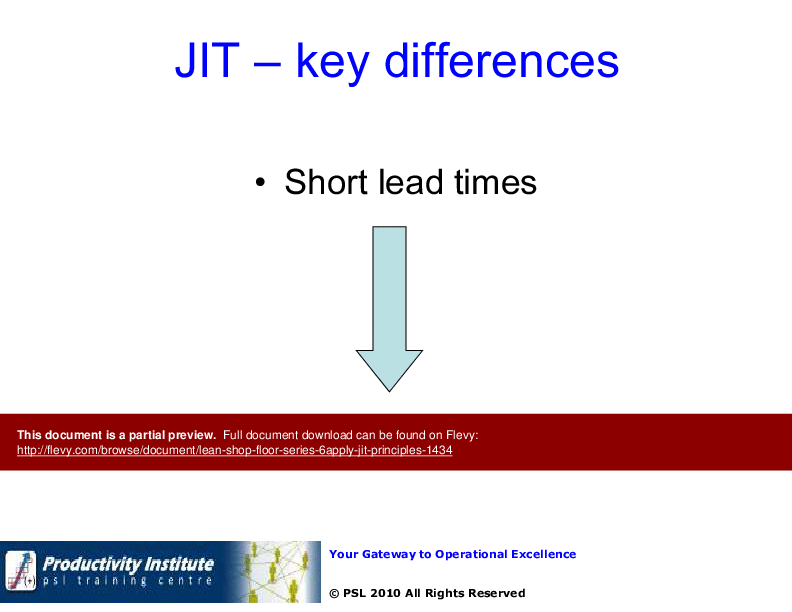
• Key Differences from Traditional Manufacturing - JIT focuses on stockless production, short lead times, and customer responsiveness, contrasting with traditional methods that rely on high inventory levels.
• Value Delivery Mechanisms - JIT delivers value through waste control, standard operations, efficient layouts, and continuous improvement practices.
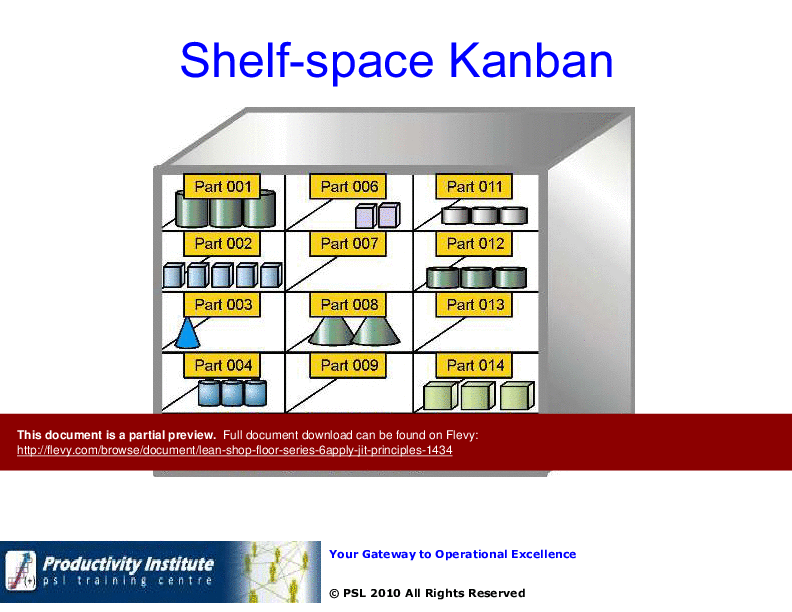
• Kanban System - Kanban serves as a visual signal to control production, facilitating pull production based on actual demand rather than forecasts.
• Support Techniques - Techniques such as workplace organization (5S), visual management, quick changeover, and total productive maintenance support JIT implementation.
• Process Improvements - Emphasizes the elimination of waste and the importance of physical layout and linking processes for efficiency.
Deliverables, Templates, and Tools
• JIT implementation checklist template
• Kanban board example for visual management
• 5S workplace organization guide
• Process mapping template for linking operations
• Standard operating procedure (SOP) template for standardized work
• Continuous improvement tracking sheet
Slide Highlights
• Overview of JIT principles and their significance in modern manufacturing
• Comparison of push vs. pull production methods with visual examples
• Detailed explanation of the Kanban system and its types
• 5S methodology for workplace organization illustrated with diagrams
• PDCA cycle for continuous improvement with clear action steps
Potential Workshop Agenda
Introduction to JIT Concepts (60 minutes)
• Define JIT and its importance in manufacturing
• Discuss key differences from traditional methods
Kanban and Production Leveling (90 minutes)
• Explore Kanban types and their applications
• Analyze production leveling techniques and benefits
Support Techniques for JIT (60 minutes)
• Review workplace organization and visual management strategies
• Discuss quick changeover and total productive maintenance
Process Improvements and Standardization (90 minutes)
• Identify process improvement opportunities
• Establish the principles of work standardization
Customization Guidance
• Tailor the JIT implementation checklist to reflect specific operational needs
• Adjust Kanban examples to fit the unique production environment
• Incorporate company-specific terminology in the standard operating procedures
• Modify the workshop agenda to focus on particular challenges faced by the team
Secondary Topics Covered
• Waste reduction strategies in manufacturing
• The role of workforce ownership in JIT success
• Techniques for maintaining high quality and low defect rates
• Importance of teamwork and multi-skilling in JIT environments
FAQ
What is Just in Time (JIT)?
JIT is a manufacturing philosophy that emphasizes producing only what is needed, when it is needed, to reduce waste and improve efficiency.
How does JIT differ from traditional manufacturing methods?
JIT focuses on stockless production, shorter lead times, and customer responsiveness, whereas traditional methods often rely on high inventory levels and longer production runs.
What are the key benefits of implementing JIT?
Benefits include reduced inventory costs, improved quality, increased efficiency, and enhanced customer satisfaction through timely delivery.
What is the Kanban system?
Kanban is a visual management tool that signals when to produce or replenish items, facilitating a pull production system based on actual demand.
How can workplace organization support JIT?
Effective workplace organization, such as the 5S methodology, helps eliminate waste, improve efficiency, and create a safer work environment.
What is the PDCA cycle?
The PDCA cycle stands for Plan, Do, Check, Act, and is a framework for continuous improvement in processes and operations.
How can I measure the success of JIT implementation?
Success can be measured through key performance indicators such as lead time reduction, inventory turnover rates, defect rates, and overall customer satisfaction.
What role does employee training play in JIT?
Training ensures that employees understand JIT principles, support techniques, and their roles in maintaining efficient and responsive production processes.
Glossary
• Just in Time (JIT) - A manufacturing philosophy focused on producing only what is needed when it is needed.
• Kanban - A visual signal used to control production and inventory levels.
• 5S - A workplace organization method that includes Sort, Set, Shine, Standardize, and Sustain.
• Continuous Improvement - An ongoing effort to improve products, services, or processes.
• PDCA Cycle - A four-step management method for continuous improvement: Plan, Do, Check, Act.
• Pull Production - A production strategy that initiates production based on actual demand rather than forecasts.
• Standard Operating Procedure (SOP) - A document that outlines the steps necessary to perform a task consistently.
• Work Standardization - The process of establishing consistent methods for performing tasks to ensure quality and efficiency.
• Total Productive Maintenance (TPM) - A maintenance approach aimed at preventing equipment breakdowns and ensuring operational efficiency.
• Waste - Any activity that does not add value to the product or service.
• Process Layout - An arrangement of equipment based on the sequence of operations.
• Cellular Layout - A layout that groups together machines and workstations to facilitate smooth workflow and reduce transport time.
• Visual Management - The use of visual cues to communicate information about processes and performance.
• Quality Management - The act of overseeing all activities and tasks needed to maintain a desired level of excellence.
• Defect Rate - The percentage of defective items produced in a manufacturing process.
• Customer Responsiveness - The ability of a company to respond quickly to customer needs and demands.
• Efficiency - The ability to produce a desired output with minimal waste of resources.
• Team Spirit - The feeling of camaraderie and cooperation among team members.
• Flexibility - The ability to adapt to changing conditions or requirements in the production process.
• Productivity - The measure of output per unit of input in a production process.
Source: Best Practices in JIT, Shop Floor PowerPoint Slides: Lean Shop Floor YB Series - 6. Apply JIT Principles PowerPoint (PPT) Presentation Slide Deck, OpEx Academy NZ
This document is available as part of the following discounted bundle(s):
Save %!
Lean Shop Floor / Yellow Belt Training Series - 8 Modules
This bundle contains 8 total documents. See all the documents to the right.
|
Receive our FREE presentation on Operational Excellence
This 50-slide presentation provides a high-level introduction to the 4 Building Blocks of Operational Excellence. Achieving OpEx requires the implementation of a Business Execution System that integrates these 4 building blocks. |